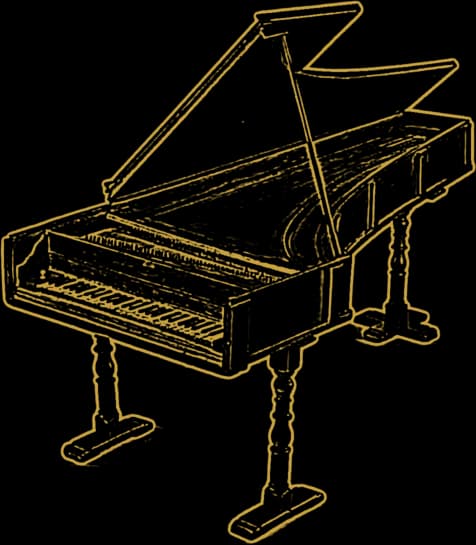
Piano
Florence, around 1700
The piano was invented to fix one thing the harpsichord could not do: play louder or softer depending on the touch. In little more than a century it became the instrument of home, study and concert hall.
Works for pianoHow it works
Each key throws a felt-covered hammer at the string, and the hammer falls straight back so the string can ring. The harder the touch, the faster the hammer and the louder the sound. When the key is released, a damper lands on the string and stops it. The right pedal lifts every damper at once, so notes keep sounding. In the treble each note has three strings tuned together; in the bass, one or two thick strings wound with copper.
The story
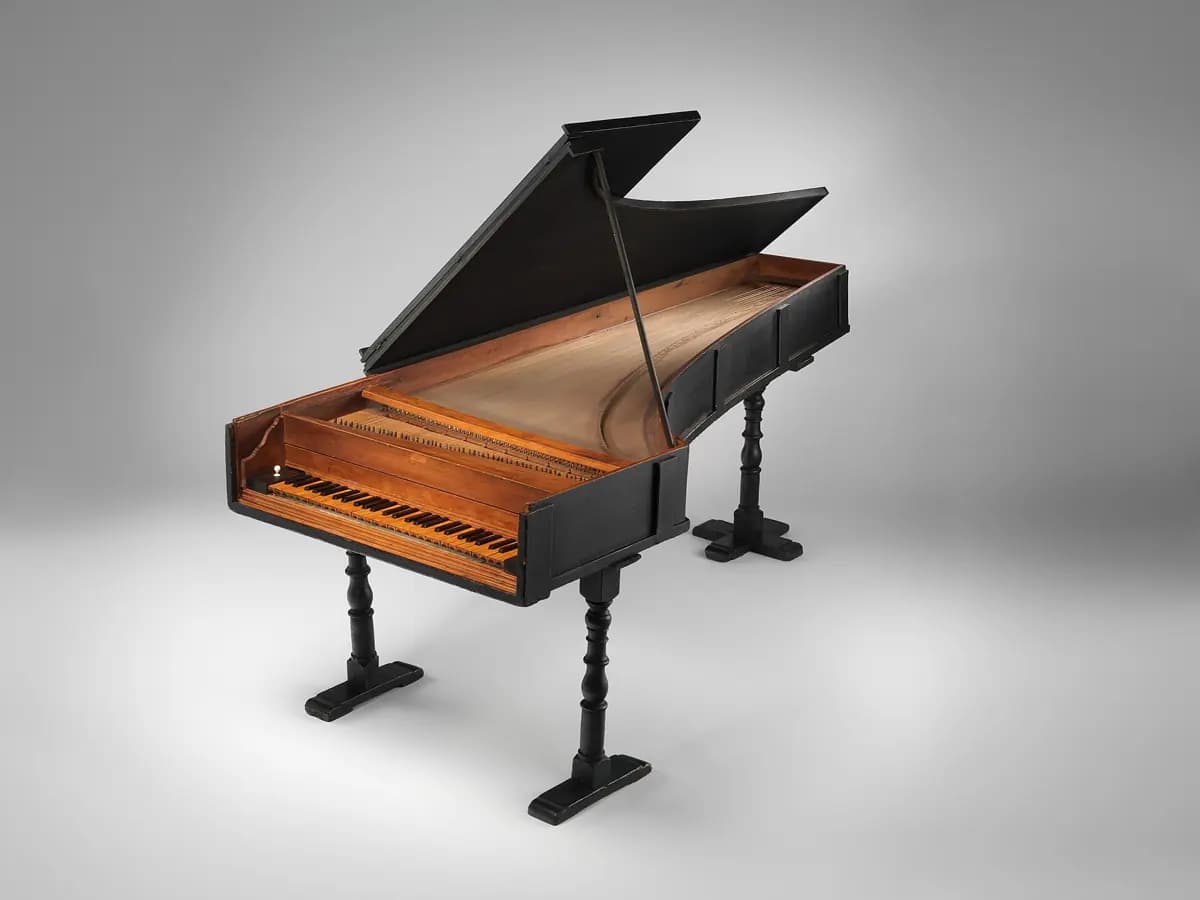
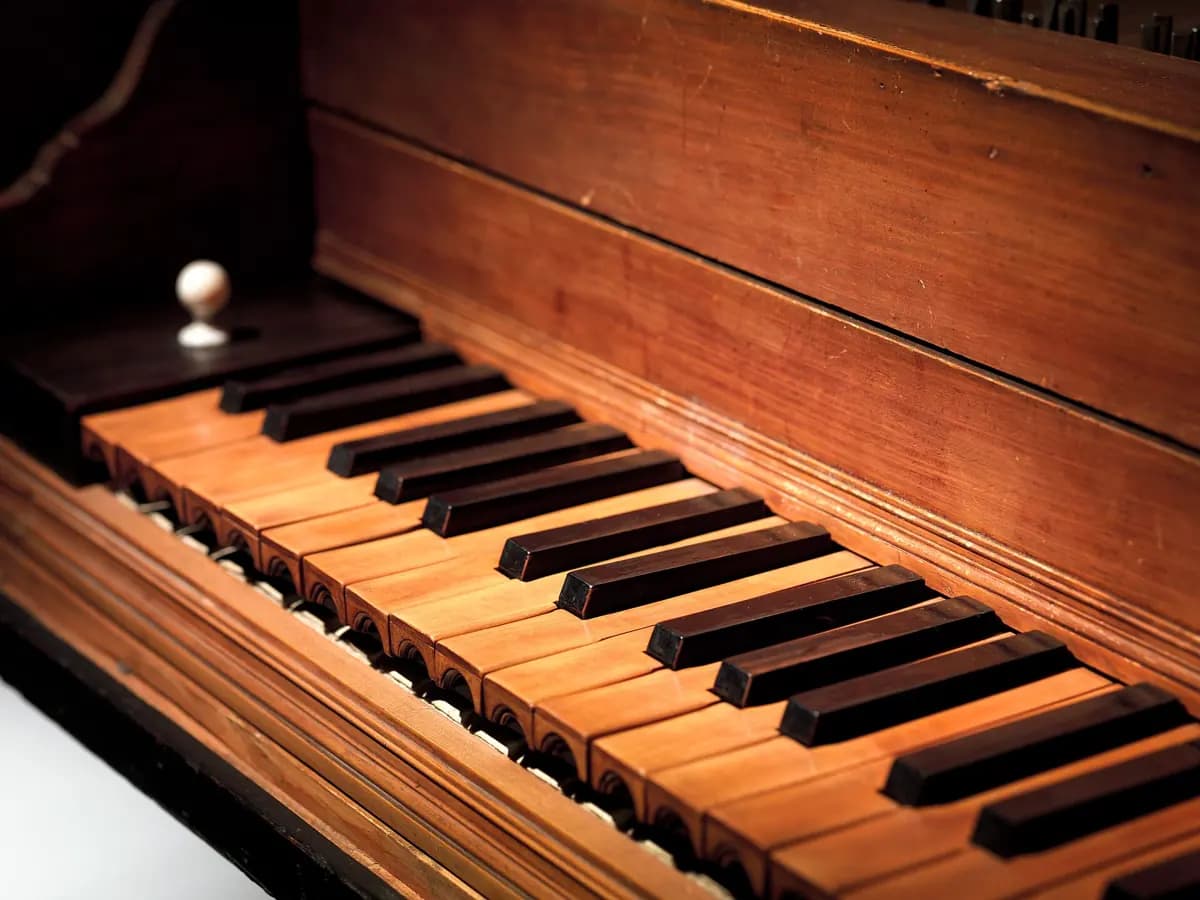
Bartolomeo Cristofori looked after the Medici family’s instruments in Florence, and around 1700 he built a harpsichord with hammers instead of quills. He called it gravicembalo col piano e forte, a harpsichord with soft and loud. The name shrank to pianoforte, then to piano. The key to the invention was the escapement, which lets the hammer drop back the instant it strikes.
In the eighteenth century, German and Austrian builders improved the idea. Mozart played light, clear Viennese pianos. Beethoven wanted more volume and deeper bass, and heavier English pianos reached him. In 1821, in Paris, Sébastien Érard patented the double escapement, which lets a note be repeated very fast, the basis of Liszt’s virtuoso technique.
The next leap came with iron. Cast-iron frames held strings at far higher tension for a fuller sound, and in 1859 Steinway in New York crossed the bass strings over the middle ones. By the end of the nineteenth century the piano had the shape and the 88 keys it has today.
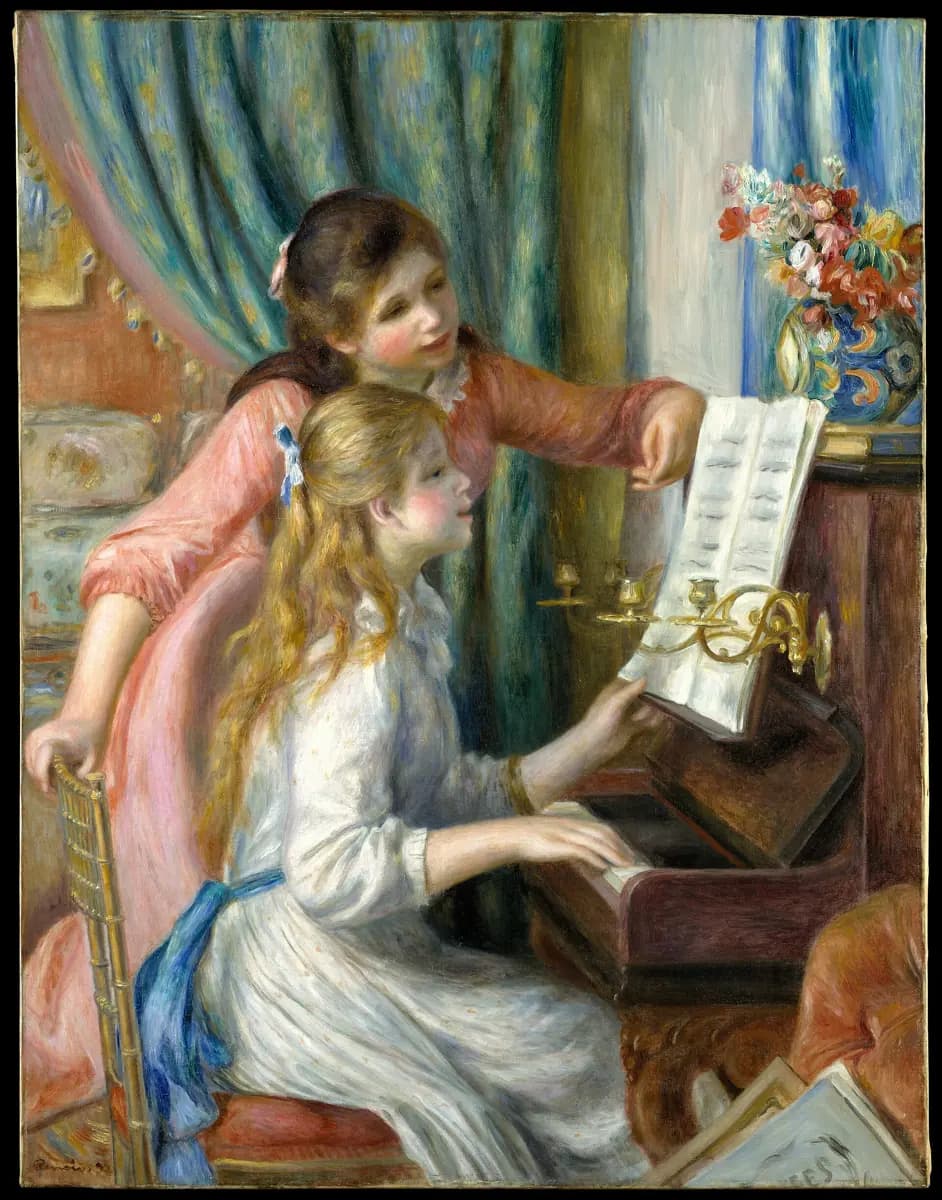
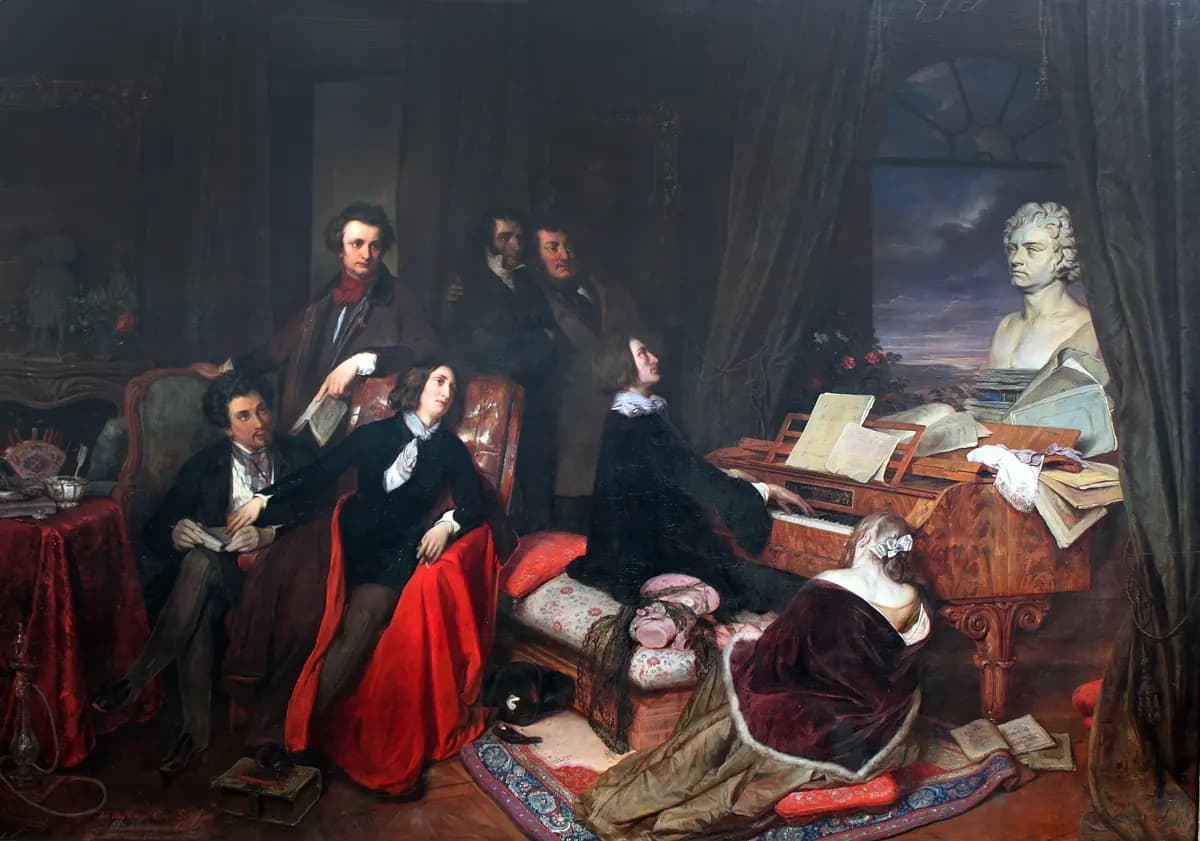
In the nineteenth century the piano left the palaces for middle-class homes. Factories built thousands a year, publishers sold arrangements of operas and symphonies to play in the parlor, and learning the piano became part of a good education, especially for young women. Before recordings, this was how a symphony reached the home: reduced for two or four hands.
In Brazil the piano took hold with the arrival of the Portuguese court in 1808 and spread through the homes of Rio de Janeiro so widely that the writer Araújo Porto-Alegre nicknamed the city Pianópolis. At the piano, Chiquinha Gonzaga and Ernesto Nazareth blended the polka, the lundu and the maxixe and helped create the Brazilian tango and choro.
What was written for it
Almost every great composer wrote for the piano. Mozart left concertos in which he was the soloist. Beethoven’s 32 sonatas span his whole life. Chopin wrote almost only for the instrument, Liszt pushed its technique to the limit, and Debussy and Ravel explored its colours. In the twentieth century, Rachmaninoff, Prokofiev and Villa-Lobos carried the tradition on.
In pictures
Where to start listening
- 1Sonata in C major, K. 545Wolfgang Amadeus MozartWritten “for beginners,” clear and cheerful. Many people learn to play with it. Open the work
- 2Ballade No. 1, Op. 23Frédéric ChopinTen minutes of drama: it begins in a whisper and ends in a storm. Open the work
- 3Clair de luneClaude DebussyThe pedal lets the notes blend like light on water. Open the work
- 4Piano Concerto No. 2Sergei RachmaninoffIt opens with chords like tolling bells and grows into huge melodies. Open the work
Where to start playing
Pieces chosen by the house, at the level rated by the musicians of IMSLP.
Beginner
- Anfangs-Stunden, Op.117Cornelius GurlittWritten for the first lessons: hands close to the keys and short phrases.
- Minuet in F major, K.2Wolfgang Amadeus MozartMozart wrote this minuet at six. It fits the hands of a beginner.
- Ecossaise, WoO 86Ludwig van BeethovenA dance of a few bars, written by Beethoven late in life.
- Notebook for Anna Magdalena BachJohann Sebastian BachMusic from Bach's home, made for the family: short dances and songs.
- Minuet in GChristian PezoldThe minuet nearly every student plays. Long credited to Bach, it is by Christian Pezold.
- Musette in D major, BWV Anh.126Johann Sebastian BachCheerful, with octave leaps in the left hand: a first test of moving around the keyboard.
- 12 Ecossaises, D.299Franz SchubertShort, characterful dances by Schubert, to practise rhythm and lightness.
- 25 Easy and Progressive StudiesFriedrich BurgmüllerEach study has a title and a character: technique arrives as music.
- For Children, Sz.42Béla BartókHungarian and Slovak folk songs, in simple and colourful writing.
Intermediate
- Album for the YoungRobert SchumannSchumann wrote it for his daughters. It starts simple and grows with the student.
- Clementi's SonatinasMuzio ClementiSonata form on a small scale: the way into Mozart and Beethoven.
- Two-Part InventionsJohann Sebastian BachBach wrote them to teach hearing and playing two independent voices.
- Waltz in A minor, B.150Frédéric ChopinA short waltz and a good first piece of Chopin.
- Para ElisaLudwig van BeethovenThe theme is famous; the middle sections ask for more than it suggests.
- 11 Bagatelles, Op.119Ludwig van BeethovenBrief pieces by Beethoven, each with an idea of its own.
- Sonata facileWolfgang Amadeus MozartMozart noted it as a sonata for beginners, but the clarity it asks for is hard to reach.
- GimnopédiasErik SatieFew notes and much time: the study here is sound and pedal.
Advanced
- 15 Sinfonias, BWV 787-801Johann Sebastian BachThe sequel to the Inventions, now in three voices.
- Nocturnes, Op.9Frédéric ChopinChopin's best-known nocturnes: song in the right hand, and rubato.
- 3 Intermezzi, Op.117Johannes BrahmsLate Brahms: it asks for sound and phrasing more than speed.
- Moonlight SonataLudwig van BeethovenThe Moonlight Sonata: the first movement is the most played, the last is what demands the level.
- Études, Op.10Frédéric ChopinStudies that are concert works: each one solves a technical problem.
- Ballade No.1Frédéric ChopinOne of the great works of the Romantic repertoire, narrative and virtuosic.
Did you know?
- The oldest surviving Cristofori piano, from 1720, is at the Metropolitan Museum in New York and can still be played.
- Added together, the strings of a grand piano pull on its frame with a force of about twenty tonnes.