Theobald Boehm
- Born
- 9 April 1794
- Died
- 25 November 1881
- aged 87
- Country
- Germany
- Era
- Classical
Theobald Böhm
Biography
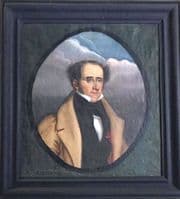
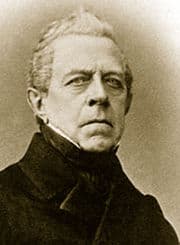
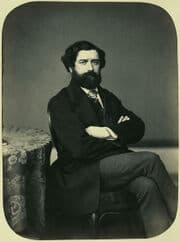
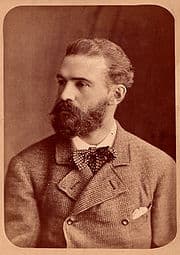
Theobald Böhm was born on 9 April 1794 in Munich, then part of the Electorate of Bavaria, and died on 25 November 1881. He was of German nationality and distinguished himself as a court musician, virtuoso flautist and composer.
Son of the goldsmith Carl Friedrich Böhm, he learned the goldsmith’s trade in childhood, which allowed him to make his own instruments. At the age of seventeen he joined an orchestra, and at twenty‑one he was appointed principal flautist of the Royal Bavarian Orchestra. At the same time, he studied acoustics at the Ludwig‑Maximilians University of Munich, where he deepened the knowledge that would become the basis of his innovations in flute playing.
Böhm’s main contribution was the reform of the transverse flute’s fingering system, patented in 1847 and described in his treatise Über den Flötenbau, published the same year. The new model, presented at the 1851 London Exhibition, introduced mechanical keys that eliminated the limitation imposed on the reach of the holes, allowing the construction of larger flutes, such as the alto, to which Böhm was particularly devoted. In 1871 he published Die Flöte und das Flötenspiel, a work dealing with the acoustic, technical and artistic aspects of the instrument that bears his name.
As a composer, Boehm wrote works for flute and piano, among which the Grand Polonaise in D Major, Op. 16, the Variations sur un air tyrolien, Op. 20, and the Andante for Flute and Piano, Op. 33, stand out, in addition to collections of studies and caprices that reveal his mastery of flute technique. His fingering system was later adapted to clarinet, oboe and saxophone, directly influencing the development of the “Böhm system” in those instruments.
The most striking aspect of his personal life was the union of the family goldsmith trade and musical practice, which gave him the unique ability to design and manufacture flutes with scientific precision. This combination of craftsmanship and science made Theobald Böhm a central figure in the history of Western wind instruments, whose legacy remains alive in the instruments still in use today.
Written by artificial intelligence and not yet reviewed by a person.
Where to start
Curiosities
Nobody has shared a curiosity about Boehm yet. The first one earns XP.
Works
18 works- Divertissement sur un motif de Rovelli, Op.10Flauta
- Fantaisie sur des thèmes suisses, Op.23Piano
- Fantasie sur un air de F. Schubert, Op.21Flauta · Advanced
- Rondo à la Mazurka, Op.36Flauta
- Souvenir des Alpes, Opp.27-32Flauta
- Variations sur 'Nel cor più', Op.4Flauta
- Variations sur un Air Allemand, Op.22Flauta
- Variations sur un air tyrolien, Op.20Flauta
- 12 Etudes, Op.15Flauta
- 24 Caprices-etudes, Op.26Flauta
- 24 Etudes, Op.37Flauta
- Andante for Flute and Piano, Op.33Flauta
- Compositionen berühmter MeisterFlauta
- Divertissement sur un air de Carafa, Op.6Flauta
- Elegy, Op.47Flauta · Advanced
- Fantaisie sur des thèmes suisses, Op.24Flauta
- Fantaisie sur un air de Beethoven, Op.21Flauta
- Variations on an Andante by Beethoven, Op.46Flauta




Something wrong on this page? or send a missing work.