Gustav Mahler
- Born
- 7 July 1860
- Died
- 18 May 1911
- aged 50
- Country
- Austria
- Era
- Romantic
Biography
Gustav Mahler was born on July 7, 1860, in the Bohemian village of Kaliště, then part of the Austro‑Hungarian Empire, and died on May 18, 1911. Of Austrian nationality, he was of Jewish origin and grew up in a German‑speaking environment. From a very early age he stood out as a prodigy on the piano, giving public performances at ten years old. His childhood was marked by family losses, such as the death of his brother Ernst in 1875, an event that led him to seek consolation in music.
He trained at the Vienna Conservatory (1875‑1878), where he studied piano with Julius Epstein and, in the last two years, composition and harmony under the guidance of Robert Fuchs and Franz Krenn. Although he was never an official pupil of Anton Bruckner, he attended some of Bruckner’s lectures and was influenced by his choral writing; a fascination with Richard Wagner also marked his formation, especially the sonic aspect of Wagner’s works. In 1880 he completed the dramatic cantata Das klagende Lied, his first substantial composition, which was only presented in a revised version in 1901.
Mahler’s career developed mainly as an opera conductor. His first posts included directing a theatre in Bad Hall (1880) and, subsequently, engagements in Laibach, Olomouc, Kassel and Leipzig, culminating in his appointment in 1897 as director of the Imperial Opera in Vienna. To obtain the post he converted to Catholicism, but he faced strong hostility from anti‑Semitic press. His demanding method and innovations in opera production consolidated him as one of the greatest conductors of Wagner, Mozart and Tchaikovsky. As a composer he kept writing alongside his conducting duties, producing works for large orchestral forces, choirs and soloists; among them stand out the Second Symphony, the triumphant premiere of the Eighth Symphony in 1910 and the song cycle Lieder eines fahrenden Gesellen. His music, initially controversial, became widely recognized after the Second World War, influencing the Second Viennese School (Schoenberg, Berg, Webern) and later composers such as Shostakovich and Britten.
The historical importance of Mahler lies in his role as a bridge between the nineteenth‑century tradition and early‑twentieth‑century modernism, combining Bruckner’s symphonic tradition with an expressive, introspective discourse. The belated recognition of his oeuvre led to the creation of the International Gustav Mahler Society in 1955, which preserves his legacy. A striking aspect of his personal life was the sense of exile he carried from childhood, reinforced by the necessity of religious conversion to advance his career, reflecting the constant tension between cultural identity and artistic aspirations.
Written by artificial intelligence and not yet reviewed by a person.
Where to start
Curiosities
- His symphonies are among the longest ever written, some lasting over 90 minutes.
- Included human voices in several of his symphonies.
- Said that "a symphony must contain the whole world".
- Was one of the most important conductors of his time, directing the Vienna Opera.
Works
27 works- Symphony No.5, GMW 44Mahler's Fifth · Orquestra · 1902 (revisada several times from 1904-1911)
- Symphony No.1, GMW 11Titan Symphony · Orquestra · 1884-88
- Symphony No.2, GMW 30Resurrection Symphony · Orquestra · 1888-94, rev.1903
- Das Lied von der Erde, GMW 49, GMW 49-O (Orchestral Version) ; GMW 49-K (Piano Version)The Song of the Earth · Voz · 1908–09
- Kindertotenlieder, GMW 45, GMW 45-O (Orchestral Version ; GMW 45-K (Piano Version)Songs on the Death of Children · Voz · 1901-04
- Symphony No.6, GMW 46Tragic Symphony · Orquestra · 1903-04
- Symphony No.8, GMW 48Symphony of a Thousand · Orquestra · 1906–07
- Totenfeier, GMW 30Orquestra · 1888-94, rev.1903
- Urlicht, GMW 30Orquestra · 1888-94, rev.1903
- Urlicht, GMW 30Orquestra · 1888-94, rev.1903
- Symphony No. 4 (Schumann, Robert), Op.120Orquestra · 1841 (junho de 1841), revisada em 1851 (June)
- Piano Quartet, GMW F52Violino · 1876 ca.
- Symphony No.4, GMW 37Soprano · 1900-01
- Rückert Lieder, GMW 39-43, GMW (O) 39-42 (Orchestral Version) ; GMW (K) 39-43 (Piano Version)Voz · 1901-02
- Des Knaben Wunderhorn, GMW 21-29, 32-36, 38, GMW (O) 21-29, 32-36, 38 (Orchestral Version) ; GMW (K) 21-29, 32-36, 38 (Piano Version)Voz · 1892-96, revisada em 1899-1901
- Lieder eines fahrenden Gesellen, GMW 10, GMW 10-O (Orchestral Version) ; GMW 10-K (Piano Version)Orquestra · 1883-85
- Symphony No.3, GMW 31Contralto · 1896
- Symphony No.9, GMW 50Orquestra · 1909-10
- Symphony No.10, GMW F58Orquestra · 1910
- Symphony No.7, GMW 47Orquestra · 1904-06
- Lieder und Gesänge aus der JugendzeitVoz · 1880-89
- Das Klagende Lied, GMW 1, GMW 1a-cOrquestra · 1878-80, rev. 1892-93, 1898-99
- SongsVoz
- Scherzo in C minor, GMW F55Orquestra · 1897-1907 ca.
- Im wunderschönen Monat Mai, GMW F51bVoz
- 3 Lieder, GMW 2-4Tenor · 1880/02-03
- Es fiel ein Reif in der Frühlingsnacht, GMW F51aVoz
Further reading
See the blog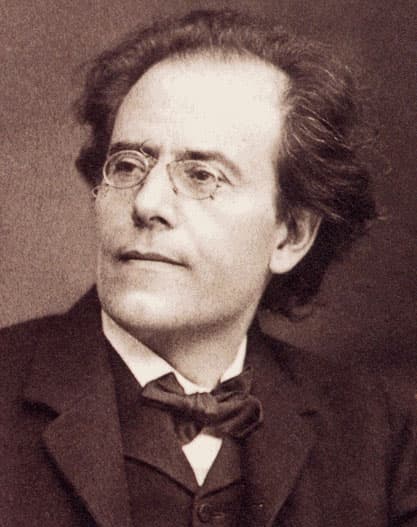







Something wrong on this page? or send a missing work.