Johann Sebastian Bach
- Born
- 21 March 1685
- Died
- 28 July 1750
- aged 65
- Country
- Germany
- Era
- Baroque
Jean Sébastien Bach · Jan Sebastian Bach · John Sebastian Bach
Biography
Johann Sebastian Bach was born on 21 March 1685 (31 March in the Gregorian calendar) in Eisenach, then in the duchy of Saxe‑Eisenach, and died on 28 July 1750. He was of German nationality and became known as one of the greatest composers of the late Baroque period.
The son of the town musician Johann Ambrosius Bach, he was orphaned at ten and spent five years with his older brother Johann Christoph before continuing his musical training in Lüneburg, where he studied at St Michael’s School, sang in the choir, received organ lessons and had access to a large library. He was influenced by the organist Johann Adam Reincken and, above all, the famous Danish‑German organist Dieterich Buxtehude, whom he visited in Lübeck, as well as by the contrapuntal traditions of the South‑German school of Johann Pachelbel, whose works he copied already in his adolescence.
Bach’s style is distinguished by the mastery of counterpoint, by his command of techniques such as canon and fugue, and by his harmonic and motivic organization. He incorporated rhythms, forms and textures of Italian and French music into the German repertoire, adapting Lutheran hymns both in extensive choral works and in simple four‑part chorales.
Among the most representative works are the Brandenburg Concertos, the Cello Suites, the Sonatas and Partitas for solo violin, the Goldberg Variations and The Well‑Tempered Clavier, the Toccata and Fugue in D minor, the Schübler Chorales, the St Matthew Passion, the Mass in B minor, the Musical Offering and The Art of Fugue. He composed hundreds of sacred and secular cantatas, chamber music, violin and harpsichord concertos, as well as a vast repertoire for organ and other keyboard instruments.
Bach held positions in several Protestant cities: organist in Arnstadt and Mühlhausen, Kapellmeister in Köthen, where he devoted himself mainly to chamber music, and, from 1723, Thomaskantor in Leipzig, responsible for the music of four Lutheran churches and the St Thomas school. He received, in 1736, the title of court composer to the Elector of Saxony. In his personal life, he was widowed from Maria Barbara Bach in 1720, married the soprano Anna Magdalena Wilcke in 1721 and had twenty children, of whom four pursued musical careers. He died in Leipzig after complications from eye surgery, leaving a legacy that would only be fully recognized after the “Bach Revival” initiated by Felix Mendelssohn in 1829.
Written by artificial intelligence and not yet reviewed by a person.
Where to start
Curiosities
- Had 20 children, several of whom became famous composers.
- Used numbers and mathematical proportions as the basis for his compositions.
- Walked over 400 km to hear Dietrich Buxtehude play organ.
- Many of his works were lost and rediscovered centuries later.
Works
1,426 works- 6 Violin Sonatas and Partitas, BWV 1001-1006Sonatas and Partitas for Solo Violin · Violino · 1720
- Klavierbüchlein für Anna Magdalena Bach 1722Notebook for Anna Magdalena Bach · Teclado
- Notebooks for Anna Magdalena BachNotebook for Anna Magdalena Bach · Teclado · Beginner
- Goldberg-Variationen, BWV 988, BWV 988 ; BC L 9 ; Op.4Goldberg Variations · Teclado
- 15 Inventions, BWV 772-786, BWV 772-786 ; BC L 27–41Two-Part Inventions · Teclado · 1720–23 in Inventions and Sinfonias · Intermediate
- 6 Cello Suites, BWV 1007-1012Cello Suites · Violoncelo · 1717-23
- Toccata and Fugue in D minor, BWV 565, BWV 565 ; BC J 37Toccata and Fugue in D minor · Órgão · 1708 ? · Intermediate
- Inventions and Sinfonias, BWV 772-801, BWV 772-801 ; BC L 27–56Inventions and Sinfonias · Teclado · 1720-23
- Orchestral Suite No.3 in D major, BWV 1068Includes Air on the G String · Orquestra · 1730 ca.
- Cello Suite No.1 in G major, BWV 1007Violoncelo · 1717-23 · Intermediate
- Prelude and Fugue in C major, BWV 846, BWV 846 ; BC L 80Teclado · 1722 in Das wohltemperierte Klavier I (No.1)
- 389 ChoralgesängeVoz
- Cello Suite No.3 in C major, BWV 1009Violoncelo · 1717-23 · Advanced
- 42 Little Keyboard PreludesTeclado
- Invention in C major, BWV 772, BWV 772, 772a ; BC L 27Teclado · 1723 in Inventions and Sinfonias*
- 371 Vierstimmige Choralgesänge, RISM A/I: B 449Voz
- Cello Suite No.2 in D minor, BWV 1008Violoncelo · 1717-23 · Advanced
- Chorale Preludes, BWV 714-765Órgão · Intermediate
- Bach-anh-114, (BWV Anh.114 ; BWV Anh. II 114 / Anh. III 183‑> ; BNB I/P/5.1)Teclado · até 1725
- 15 Sinfonias, BWV 787-801, BWV 787-801 ; BC L 42–56Teclado · 1720–23 in Inventions and Sinfonias · Advanced
- Cello Suite No.5 in C minor, BWV 1011Violoncelo · 1717-23 · Advanced
- 16 Konzerte nach verschiedenen Meistern, BWV 972–987, BWV 972–987 ; BC L 188–204Teclado · 1713–14
- 3 Sonatas for Viola da Gamba and Harpsichord, BWV 1027-1029Viola · 1730-40s
- Neumeister Chorales, BWV 1090-1120, BWV 1090-1120 ; BC K 161-194Órgão · Beginner
- Violin Partita No.1 in B minor, BWV 1002Violino · 1720 in 6 Violin Sonatas and Partitas (No.2) · Advanced
- 5 Kleine Präludien, BWV 939-943, BWV 939–943 ; BC L70–74Teclado · 1717? · Intermediate
- Musette in D major, BWV Anh.126, BWV Anh.126 ; BWV Anh. II 126Teclado · 1725 · Beginner
- Minuet in D minor, BWV Anh.132, BWV Anh.132 ; BWV Anh. II 132Teclado · 1725 · Beginner
- 4 Duettos, BWV 802-805, BWV 802-805 ; BC J 74–77 ; Op.3 Nos.23–26Duo
- Cello Suite No.4 in E-flat major, BWV 1010Violoncelo · 1717-23 · Advanced
Further reading
See the blog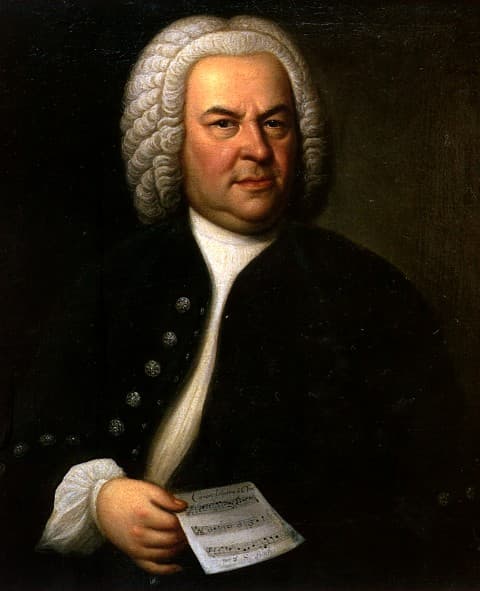




Something wrong on this page? or send a missing work.