Claude Debussy
- Born
- 22 August 1862
- Died
- 25 March 1918
- aged 55
- Country
- France
- Era
- Modernism
- Wrote for
- Piano · voz · orquestra · coro · violoncelo
Achille-Claude Debussy · Дебюсси · Клод
Biography
Claude‑Achille Debussy was born on 22 August 1862 in Saint‑Germain‑en‑Laye, France, and died on 25 March 1918 in Paris, a victim of cancer, at the age of 55. Of modest origin, he was the son of Manuel‑Achille Debussy, a china merchant, and Victorine Manoury, a seamstress, and he was the eldest of five siblings.
His admission to the Conservatoire de Paris at ten years old marked his formal training; he studied piano with Antoine François Marmontel, composition with Ernest Guiraud, harmony with Émile Durand, organ with César Franck and, although uncertain, received music‑history lessons from Louis‑Albert Bourgault‑Ducoudray. Even in childhood he took piano lessons from Jean Cerutti and later from Antoinette Mauté de Fleurville. In 1884 he won the Prix de Rome with the cantata L’enfant prodigue, after which he lived at the Villa Medici, where he composed works such as Zuleima and La Damoiselle élue, the first to reveal traits of his future style.
Debussy’s music constitutes, to a large extent, a reaction against the Germanic tradition of Wagner, whom he briefly admired but considered “a beautiful sunset confused with sunrise.” Influenced by Chopin, Liszt, Russian music, the Javanese gamelan, the works of Rimsky‑Korsakov and poetic symbolism, he developed his own harmonic language and innovative orchestral colors. He rejected the idea of the traditional symphony, preferring “symphonic sketches” such as La mer (1903–1905), and was labeled the first impressionist composer, a term he rejected.
Among his most emblematic works are Prélude à l’après‑midi d’un faune (1894), the Nocturnes (1897‑1899), the Images series (1905‑1912), the 24 Preludes and 12 Études for piano, the string quartet (premiered in 1893) and his only complete opera, Pelléas et Mélisande (1902). At the end of his life he focused on chamber music, planning six sonatas for different instrumental combinations, of which he completed three.
On a personal level, Debussy maintained striking love affairs, such as the long‑lasting bond with singer Marie Vasnier, for whom he composed 27 songs, and the scandal generated by his engagement and subsequent breakup with singer Thérèse Roger, which brought him criticism and distance from some friends. His trajectory, inserted in the modernism of the turn of the 19th‑20th century, made him one of the most influential composers of the era, impacting later generations of musicians.
Written by artificial intelligence and not yet reviewed by a person.
Where to start
Curiosities
- Created musical impressionism, inspired by impressionist painters.
- "Clair de Lune" became one of the most popular piano pieces of all time.
- Was influenced by Indonesian gamelan music after hearing it at the Paris Exposition.
- Rejected traditional harmony rules, creating a new musical vocabulary.
Works
116 works- Suite bergamasque, CD 82 ; L.75Includes Clair de Lune · Piano · 1890-1905
- Préludes, Livre 1, CD 125 ; L.117Preludes, Book 1 · Piano · 1909-10
- Children's Corner, CD 119 ; L.113Includes Golliwogg's Cakewalk… · Piano · 1906-1908
- Estampes, CD 108 ; L.100Prints · Piano · 1903 July
- Préludes, Livre 2, CD 131 ; L.123Préludes, Book 2 · Piano · 1912-13
- Prélude à l'après-midi d'un faune, CD 87 ; L.86Prelude to the Afternoon of a Faun · Orquestra · 1891-94
- 2 Arabesques, CD 74 ; L.66Two Arabesques · Piano · 1890-91
- Rêverie, CD 76 ; L.68Reverie · Piano · 1890 · Advanced
- 2 Arabèsques, CD 74 ; L.66Piano · 1890-91
- Arabesque premiere, CD 74 ; L.66Piano · 1890-91
- Syrinx, CD 137 ; L.129Flauta · 1913 · Advanced
- Beau soir, CD 84 ; L.6Voz · 1880 ca., rev.1890-91
- Cello Sonata, CD 144 ; L.135Violoncelo · 1915 (July-August) · Advanced
- Danse sacrée et danse profane, CD 113 ; L. 103Harpa · 1904 (April-May)
- Etudes, CD 143 ; L.136Piano · 1915 (July 23 to September 29)
- Ariettes oubliées, CD 63 ; L.60Voz · 1885-87, rev.1903 1 and 2: March 18873 and 4: 6 and 10 January 18855: janeiro de 1886
- Danse, CD 77 ; L.69Piano · 1890
- 2 Romances, CD 65-66 ; L.78-79Voz · 1885
- Fêtes galantes, CD 86, 114 ; L.80, 104Voz · 1891-92, 1904
- Images oubliées, CD 94 ; L.87Piano · 1894 (Winter)
- Ballade, CD 78 ; L.70Piano · 1890 · Advanced
- Apparition, CD 57 ; L.53Voz · 1884 (8 February), Ville d'Avray
- Danse bohémienne, CD 4 ; L.9Piano · 1880
- 3 Chansons de Charles d'Orléans, CD 99 ; L.92Coro · 1898 (nos.1, 3), 1908 (no.2)
- PierrotVoz · 1882
- 12 SongsVoz
- 5 Poèmes de Baudelaire, CD 70 ; L.64Voz · 1887–89
- 3 Mélodies de Verlaine, CD 85 ; L.81Voz · 1891
- Berceuse héroïque, CD 140 ; L.132Piano · 1914 (November)
- 3 Chansons de Bilitis, CD 97 ; L.90Voz · 1897-98
Further reading
See the blog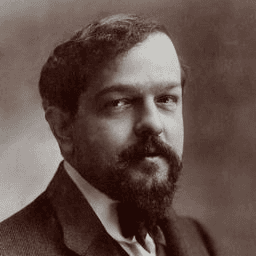


Something wrong on this page? or send a missing work.