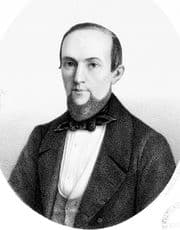
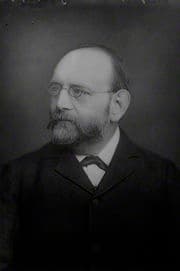
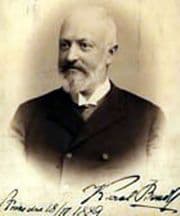
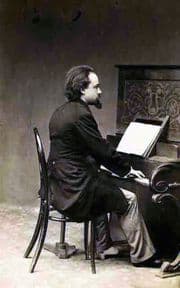
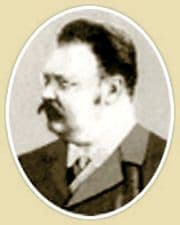
Bedřich Smetana
- Born
- 2 March 1824
- Died
- 12 May 1884
- aged 60
- Country
- Czechia
- Era
- Romantic
Friederich Smetana · Frederick Smetana · Frédéric Smetana
Biography
Bedřich Smetana was born on March 2, 1824, in the city of Litomyšl, then part of Austrian Bohemia, and died on May 12, 1884, in Prague. Of Czech origin, he was one of the main representatives of Romanticism and one of the founders of Bohemian national musical identity.
He graduated from the Prague Conservatory between 1838 and 1841, where he studied piano with Václav Tomášek and theory with Antonín Štěpán. After completing his studies, he worked as a violist in the Orchestra of the Provisional Theater (later the National Theater) and as an organist in local churches. His early compositions were influenced by German composers such as Robert Schumann and Felix Mendelssohn, but he quickly incorporated melodies and rhythms from Czech popular music, reflecting the Czech National Renaissance movement that was gaining strength in the 19th century.
Smetana's style combines European romantic tradition with dry folk elements. He uses rich harmonies, colorful orchestration and programmatic structures, especially in symphonic works. His music is marked by themes that evoke landscapes and legends of his land, as occurs in the famous series of symphonic poems “Má vlast”, whose movement “Vltava” describes the course of the Vltava river.
Among the most important works are the opera “The Sold Bride” (Prodaná nevěsta, 1866), which established the model for Czech national opera; “Dalibor” (1872) and “Libuše” (awarded in 1881). In the instrumental field, the “String Quartet in E minor, Op.1” (1855) and the collection of piano dances “Dancinhas Cchecas” stand out. Smetana also directed the Provisional Theater between 1866 and 1869, boosting the production of repertoire in the Czech language.
His path coincided with the Czech National Renaissance, a period in which intellectuals sought to assert Czech culture and language within the Austro-Hungarian Empire. Smetana became a symbol of this effort, proving that Czech music could reach the same level of excellence as the great European traditions. A striking aspect of his personal life was the progressive loss of hearing, which began around 1874 and was aggravated by health problems, which isolated him in recent years, reminiscent of Beethoven's struggle. Despite his deafness, he continued to compose until his death, leaving a legacy that defined Czech music.
Written by artificial intelligence and not yet reviewed by a person.
Where to start
Curiosities
- Is considered the father of Czech national music with "Má vlast".
- His "Moldau" musically depicts the river that flows through Prague.
- Composed his quartet "From My Life" after becoming deaf.
- His opera "The Bartered Bride" remains very popular in the Czech Republic.
Works
84 works- Má Vlast, JB 1:112, JB 1:112, T.110–111, T.113–114, T.120–121My Homeland · Orquestra · 1872–79
- Šárka, JB 1:112/3, JB 1:112/3 ; T.113Orquestra · 1875
- Piano Trio, Op.15, Op.15 ; JB 1:64Violino · 1854-55
- Blaník, JB 1:112/6, JB 1:112/6 ; T.121Orquestra · 1879
- Cadenzas for Piano Concertos by Beethoven and Mozart, Nos.1 to 3 — JB 4:4, B.103, T.85Nos.4 to 6 — JB 4:1, B.99No.7 — JB 4:2, B.98Nos.8 to 16 — JB 4:3, B.130Piano · 1857–61 (No.1), 1872 (Nos.2 and 3), 1856 (Nos.4 to 7), 1864? (Nos.8 to 16)
- Concert Etude in C major, JB 1:73, 1st version — JB 1:73, B.108, T.712nd version — JB 1:73, B.113, T.75Piano · 1858 (both versions)
- České tance I, JB 1:107, JB 1:107 ; T.112Piano · 1877
- Hubička, JB 1:104, JB 1:104 ; T.115Coro · 1875–76, rev.1877
- Na břehu mořském, JB 1:80, JB 1:80, B.119, T.86Piano · 1861-09-29
- Fantasie na české národní písně, JB 1:83, JB 1:83, B.121, T.88Piano · 1862
- 3 Polkas de salon, Op.7, Op.7 ; JB 1:60 ; B.94 ; T.62Piano · 1848–54
- Hakon Jarl, Op.16, Op.16 ; JB 1:79 ; B.118 ; T.82Orquestra · 1860–61
- Bagatelles et impromptus, JB 1:19, JB 1:19 ; B.40 ; T.27Piano · 1844
- Libuše, JB 1:102, JB 1:102, T.107Solo · 1869–72
- Ballade in E minor, JB 2:43, JB 2:43, B.107, T.70Piano · 1858
- Dalibor, JB 1:101, JB 1:101 ; B.133 ; T.96Orquestra · 1865–67, revisada em 1870
- Dvě vdovy, JB 1:108, JB 1:108 ; T.109Solo · 1873–74, revisada em 1877, 1882
- Fanfáry k Shakespearovu dramatu Richard III, JB 1:92Trompete · 1867
- 3 Polkas poétiques, Op.8, Op.8 ; JB 1:61 ; B.95 ; T.63Piano · 1848–54
- Piano Sonata in G minor, JB 3:24, JB 3:24 ; B.A76 ; T.35Piano · 1846
- 6 Characteristic Pieces, Op.1, Op.1 ; JB 1:35 ; B.57 ; T.44Piano · 1847–48
- 6 Album Leaves, Op.2, Op.2 ; JB 1:51 ; B.86 ; T.53Piano · 1849–50 · Intermediate
- Galopp di bravoura, JB 1:3, JB 1:3, B.7, T.5Piano · 1840
- Piece in A minor, JB 2:45, JB 2:45, B.D55Piano · 1862?
- 5 Waltzes, JB 1:18, JB 1:18 ; B.39 ; T.22Piano · 1844
- Oldřich and Božena, JB 1:88Orquestra · 1863
- Bettina Polka, JB 1:74, JB 1:74a ; B.114 ; T.81 - 1st version JB 1:74b ; T.81 - 2nd versionPiano · 1859 - 1st version1883 - 2ª versão
- 4 Sketches, Op.4, Op.4 ; JB 1:66 ; B.101 ; T.68Piano · 1848–57
- Louisina Polka, JB 1:1, JB 1:1 ; B.12 ; T.4Piano · 1840
- Georgina Polka, JB 1:2, JB 1:2 ; B.13 ; T.8Piano · 1840



Something wrong on this page? or send a missing work.