Igor Stravinsky
- Born
- 17 June 1882
- Died
- 6 April 1971
- aged 88
- Country
- France
- Era
- Modernism
Игорь Фёдорович Стравинский · Igor’ Fjodorovič Stravinskij · Igor Fedorovich Stravinskii
Biography
Igor Fyodorovich Stravinsky was born on 17 June 1882 in Oranienbaum (now Lomonosov), about fifty kilometres from Saint Petersburg, Russia, and died on 6 April 1971 in New York, United States, of pulmonary edema. Although Russian by origin, he acquired French citizenship in 1934 and, later, American citizenship in 1945, remaining a central figure of Modernist music.
Initially trained in law at the University of Saint Petersburg, Stravinsky studied music under the guidance of Nikolai Rimsky‑Korsakov, who gave him lessons in harmony and counterpoint and followed his development until the master’s death in 1908. The childhood spent near the Mariinsky Theatre gave him early contact with Russian, Italian and French operatic repertoire, and his talent for sight‑reading allowed him to absorb a vast library of scores, preparing him for the compositional career that would follow.
Stravinsky’s oeuvre is usually divided into three stylistic periods. In the Russian period (1913‑1920) folk and national‑tradition influences predominated, as in “Renard” (1916) and “Les noces” (1923). The neoclassical period (1920‑1951) proved marked by a return to classical forms, exemplified in the “Octeto” (1923) and the mythological cantatas “Apollon musagète” (1927) and “Oedipus rex” (1927). In the final stage, the serial, Stravinsky adopted the twelve‑tone technique of the Second Viennese School, beginning with “In Memoriam Dylan Thomas” (1954) and consolidating it in works such as “Canticum Sacrum” (1956); his last major work, “Requiem Canticles” (1966), was performed at his own funeral.
Among his most impactful contributions are the ballets created for Sergei Diaghilev’s Ballets Russes – “O Pássaro de Fogo” (1910), “Petrushka” (1911) and, above all, “A Sagração da Primavera” (1913), which caused a tumult at its premiere and revolutionized rhythmic and harmonic perception in twentieth‑century music. Other works, such as “L’Histoire du soldat” (1918) and “Les noces”, integrated popular elements (tango, waltz, ragtime) into the scholarly language, expanding the stylistic horizon of the era. His legacy influenced composers as diverse as Aaron Copland, Béla Bartók and Pierre Boulez, who recognised in Stravinsky a stimulus for innovation beyond tonality.
A striking aspect of his personal life was his marriage to his cousin Yekaterina Nosenko, performed on 24 January 1906, despite the canonical restrictions of the time. The couple had two children, Théodore and Ludmila, and the close relationship with Yekaterina, described by Stravinsky as a deep and almost fraternal friendship, marked his existence, providing him emotional support during the periods of intense artistic and geographical transformations that he crossed throughout his career.
Written by artificial intelligence and not yet reviewed by a person.
Where to start
Curiosities
- The premiere of "The Rite of Spring" caused a riot in the theater.
- Revolutionized music with complex rhythms and bold dissonances.
- Moved to the USA during World War II.
- Worked with Picasso and other avant-garde artists.
Works
109 works- The Rite of Spring, K015The Rite of Spring · Orquestra · 1910-13
- Histoire du soldat, K029Septeto · 1918
- 3 Pieces for Clarinet Solo, K033Clarinete · 1918 · Advanced
- 5 Easy Pieces, K025Piano · 1916-17
- 3 Pieces for String Quartet, K019Violino · 1914
- 3 Easy Pieces, K021Piano · 1915
- 3 Little Songs, K017Voz · 1913
- Fireworks, K007, Op.4 ; K007Orquestra · 1908-09
- 3 Poems to Japanese Lyrics, K016Voz · 1913
- Chant des bateliers du Volga, KN15Banda · 1917
- 4 Etudes, K009, Op.7 ; K009Piano · 1908 · Advanced
- Concertino, K035Violino · 1920
- 4 Russian Songs, K031Voz · 1919
- 3 Histoires pour enfants, K024Voz · 1915-17
- 2 Poems by Paul Verlaine, K011, Op.9 ; K011Barítono · 1910
- 2 Songs, K004, Op.6 ; K004Voz · 1907-08
- Apollon musagète, K048Orquestra de Cordas · 1927/07/16 - 1928/01/21 (Original)1947/09/26 (Revised)
- The Firebird (suite), K010The Firebird · Orquestra · 1911, rev. 1919 and 1945
- Berceuses du chat, K022Clarinete · 1915-16
- 8 pièces en trio, K021, 025Piano · 1915-17
- 2 Poems by Konstantin Balmont, K013Voz · 1911
- The Firebird (ballet), K010The Firebird · Orquestra · 1910
- 3 Songs from William Shakespeare, K081Viola · 1953
- 4 Norwegian Moods, K065Orquestra · 1942
- 4 Russian Peasant Songs, K028Trompa · 1914-17
- 4 Russian Songs, K083Harpa · 1953-54
- 8 Instrumental Miniatures, K037Violino · 1962
- A Sermon, a Narrative and a Prayer, K095Contralto · 1960-61
- Abraham and Isaac, K101Barítono · 1962-63
- Agon, K088Orquestra · 1954-57
Further reading
See the blog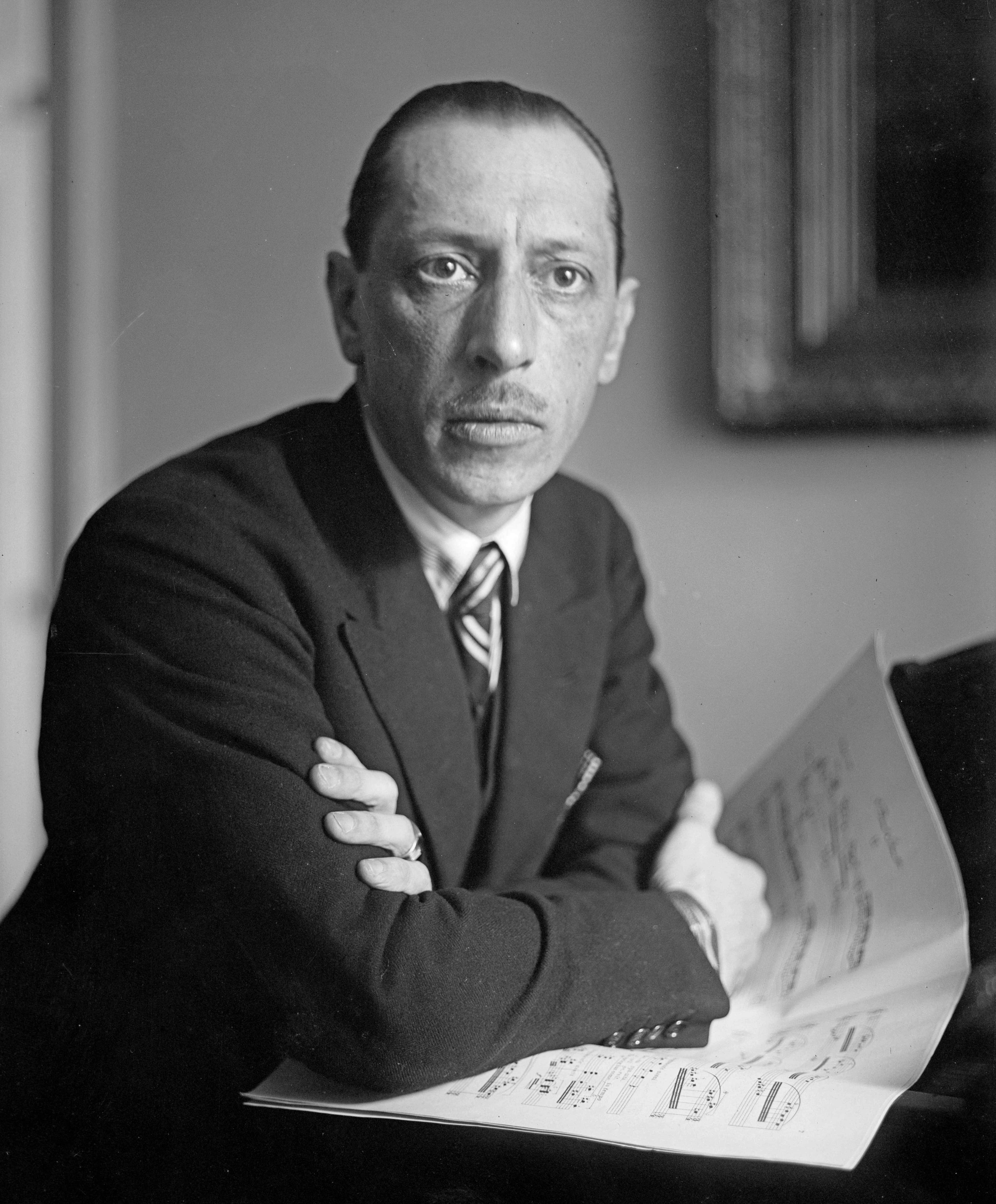



Something wrong on this page? or send a missing work.