Giuseppe Verdi
- Born
- 10 October 1813
- Died
- 27 January 1901
- aged 87
- Country
- Italy
- Era
- Classical
Giuseppe Fortunino Francesco Verdi
Biography
Giuseppe Fortunino Francesco Verdi was born on 9 or 10 October 1813, in Le Roncole, a village near Busseto, then part of the First French Empire, and died on 27 January 1901. Of Italian nationality, he became the most influential opera composer in Italy of the 19th century, succeeding Rossini, Bellini and Donizetti.
His musical training began early: he received private lessons in Latin and Italian at the age of four, studied at the gymnasium of Busseto from the age of ten, and at twelve entered the classes of Ferdinando Provesi, maestro di cappella of the local cathedral. Already at eight he was a paid organist of the church, and he developed keyboard skill by receiving a spinet from the family. In Milan, thanks to the support of Antonio Barezzi, he studied privately with Vincenzo Lavigna, maestro of La Scala, and attended performances by Rossini and Bellini. The influence of the French grand‑opera style, especially that of Meyerbeer and Spontini, also marked his development.
Verdi's style combined the Italian melodic tradition with choruses of great dramatic force, such as the famous “Va, pensiero” from Nabucco (1842), which reflected the spirit of the Italian Risorgimento. His works present complex characters and orchestration that reinforces psychological tension, with Macbeth (1847) considered his first great masterwork. The middle period brought the pillars of the repertoire – Rigoletto (1851), Il trovatore and La traviata (1853) – while the end of his career yielded late successes such as Aida (1871), the Requiem (1874), Otello (1887) and Falstaff (1893).
Verdi lived intensely within the historical context of Italian unification; his operas were seen as symbols of the national cause and he even briefly held a political function. Despite his fame, he remained a reserved person, showing strong anticlericalism that he passed on to his grandson with the warning “Sta lontan dai pret”. The early loss of his wife Margherita and of his two children, as well as the death of his sister Giuseppa, marked his personal life, reinforcing the image of a man who balances fiery artistic work with a private and moving existence.
Written by artificial intelligence and not yet reviewed by a person.
Where to start
Curiosities
- After losing his wife and two young children and seeing an opera fail, he vowed never to compose again; the libretto of Nabucco changed his mind.
- The 'Va, pensiero' chorus from Nabucco became an unofficial anthem of the Italian unification movement.
- After Aida he still wrote the Requiem, Otello and, at 79, Falstaff.
Works
47 works- RequiemVerdi's Requiem · Orquestra · 1874, rev.1875
- Il trovatoreThe Troubadour · Orquestra · 1852-53
- La forza del destinoThe Force of Destiny · Orquestra · 1862, revisada em 1868-69
- Un ballo in mascheraA Masked Ball · Coro · 1859
- NabuccoIncludes Va, pensiero · Orquestra · 1841
- La traviataIncludes Drinking Song · Orquestra · 1853, revisada em 1854, 1864
- RigolettoIncludes La donna è mobile · Orquestra
- AïdaIncludes Triumphal March · Orquestra · 1870–71
- Don CarlosOrquestra · 1867-1886
- OtelloCoro · 1885
- Les vêpres siciliennesOrquestra · 1852-55
- MacbethOrquestra · 1847
- Songs for Voice and PianoVoz
- FalstaffCoro · 1893
- 4 Pezzi sacriCoro
- Simon BoccanegraCoro · 1857, revisada em 1881
- String QuartetViolino · 1873
- I Lombardi alla prima crociataOrquestra · 1843
- Luisa MillerOrquestra · 1849
- ErnaniCoro · 1844
- AttilaCoro · 1846
- Giovanna d'ArcoCoro · 1845
- Un giorno di regnoCoro · 1840
- I due FoscariOrquestra
- I masnadieriCoro · 1847
- La battaglia di LegnanoOrquestra · 1849
- AroldoOrquestra · 1856–57 (rev. of Stiffelio)
- Il corsaroCoro · 1848
- Waltz in F majorPiano · 1859
- ObertoCoro · 1839
Further reading
See the blog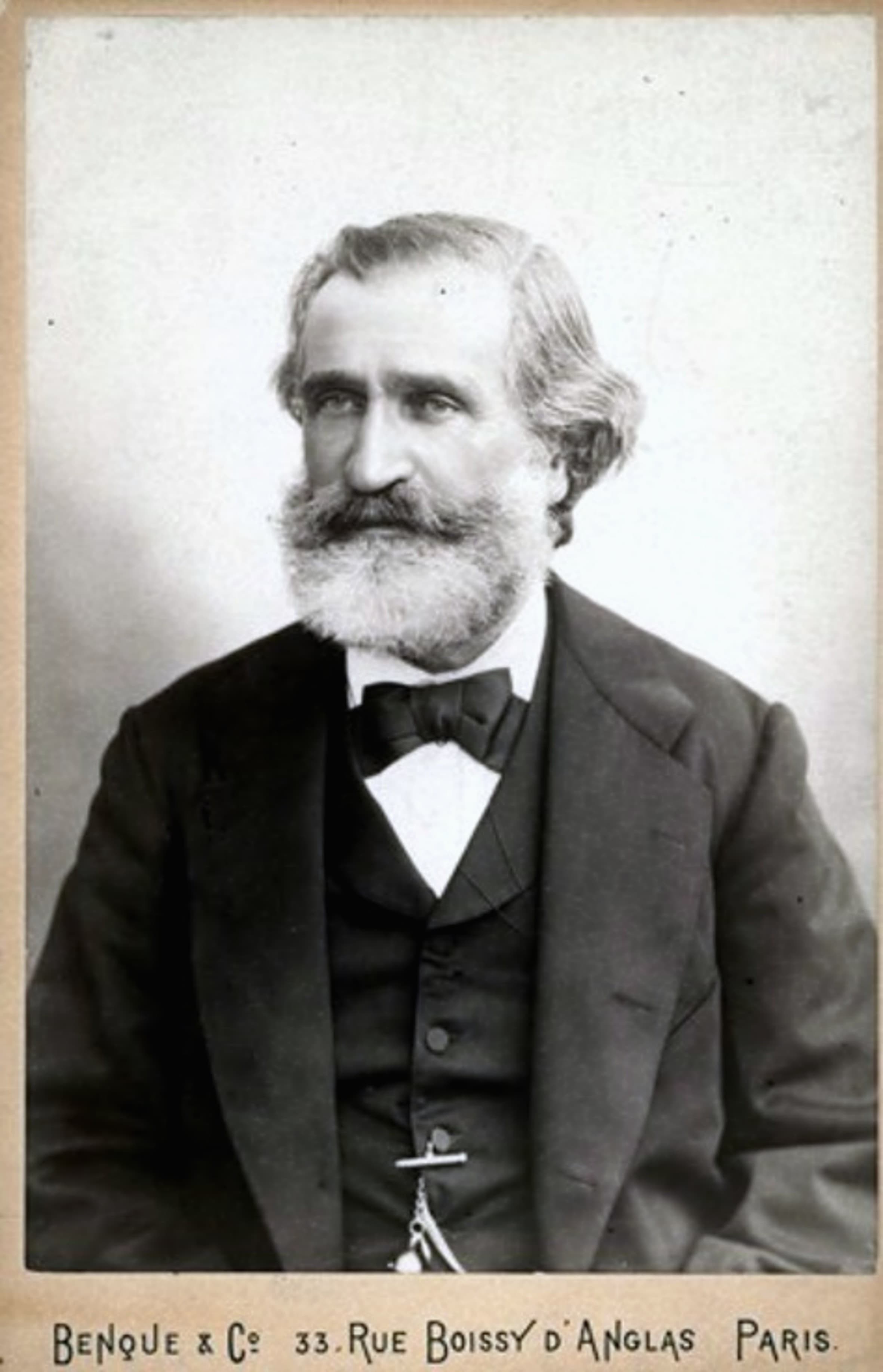





Something wrong on this page? or send a missing work.