Frédéric Chopin
- Born
- 1 March 1810
- Died
- 17 October 1849
- aged 39
- Country
- Poland
- Era
- Romantic
- Wrote for
- Piano · orquestra · violoncelo · violino · voz
Frédéric François Chopin · Fryderyk Franciszek Chopin · Fryderyk Franciszek Szopen
Biography
Frédéric François Chopin was born on March 1, 1810 in Żelazowa Wola, then part of the Partition of Poland, and died on October 17, 1849 in Paris, where he spent most of his adult life. Of Polish nationality, he maintained a strong cultural connection with his homeland throughout his career, although he never returned to the country after moving to France in 1831.
His musical training began early, under the guidance of his father, who gave him piano lessons, and was consolidated during his years of study at the Warsaw Conservatory, where his main teacher was the composer Józef Elsner. Elsner encouraged Chopin's interest in classical forms and Polish folk music; Furthermore, the young composer absorbed influences from Johann Sebastian Bach, Wolfgang Amadeus Mozart and Franz Schubert, who served as a harmonically innovative and melodic reference.
In style, Chopin stood out for exploring the sonority and expressiveness of the piano, developing a characteristic use of rubato, subtle pedals and chromatic harmonies that were advanced for the time. His compositions for solo piano – preludes, nocturnes, mazurkas, polonaises, ballads, scherzos and studies – combine classical formal structure with his own emotive language, often incorporating rhythms and melodies from Polish popular music.
Among the most representative works are the 24 Preludes Op.28, the two sets of Studies Op.10 and Op.25, the four Ballads, the two Piano Concertos, as well as countless Mazurkas, Polonaises and Nocturnos that consolidated the piano repertoire. His contribution lies both in the renewal of pianistic technique and in the creation of a repertoire that elevated the instrument to a vehicle of profound individual expression, influencing subsequent generations of composers.
Contextualized in the beginning of Romanticism, Chopin lived in the midst of a Europe marked by political revolts and the exile of Polish intellectuals. In Paris, he joined artistic circles and maintained a notorious love relationship with the writer George Sand, a relationship that, together with his fragile health – he suffered from tuberculosis –, had a profound impact on his personal life and the production of his works, imbued with a melancholy and sensitivity that are still revered.
Written by artificial intelligence and not yet reviewed by a person.
Where to start
Watch
Curiosities
- His heart is buried in Warsaw, but his body in Paris.
- Almost all his music was composed for solo piano.
- Had a tempestuous relationship with writer George Sand.
- Spent most of his adult life in Paris, but always felt nostalgic for Poland.
Works
179 works- Ballade No.1, Op.23Ballade No.1 · Piano · 1831? (first versão), 1834-35? (final versão) · Advanced
- Fantaisie-impromptu, Op.66, Op.66 ; Oeuvr. posth. Liv. 1Fantaisie-Impromptu · Piano · 1834-35 · Advanced
- Piano Sonata No.2, Op.35Funeral March Sonata · Piano · 1837 (3rd mvt), 1839 (the rest) · Advanced
- Preludes, Op.28, Op.28 ; C.166-189Includes Raindrop… · Piano · 1838-39 · Intermediate
- Nocturnes, Op.9Includes Nocturne in E-flat major · Piano · 1830-31 · Advanced
- Waltzes, Op.69Includes Farewell Waltz · Piano · 1835 (No.1), 1829 (No.2) · Intermediate
- Études, Op.10Includes Revolutionary Étude… · Piano · 1829-32 · Advanced
- Prelude in E-flat minor, Op.28 ; C.166-189Piano · 1838-39
- Waltz in A minor, B.150, B.150 ; CT 224Piano · 1847-49 ca. · Intermediate
- Chopin - Nocturne Op.Posth. C sharp minor - Wiener Urtext Edition, B.49Piano · 1830
- Andante spianato et Grande polonaise brillante, Op.22Piano · 1831 (Grand polonaise brillante), 1834 (Andante spianato)
- Ballade No.4, Op.52Piano · 1842 (revisada em 1843) · Advanced
- Ballade No.3, Op.47Piano · 1841 · Advanced
- Waltzes, Op.34Piano · 1835 (No.1), 1838 (Nos.2-3) · Advanced
- Nocturnes, Op.48, Op.48 ; CT 120, 121Piano · 1841 · Advanced
- Nocturne in C minor, B.108, B.108 ; C.128Piano · 1837
- Ballade No.2, Op.38Piano · 1836-39 · Advanced
- Cello Sonata, Op.65Violoncelo · 1846-1847 (summer) · Intermediate
- Barcarolle, Op.60Piano · 1845-46 · Advanced
- Berceuse, Op.57Piano · 1843-44 · Advanced
- Fantaisie, Op.49Piano · 1841 · Advanced
- NocturnesPiano
- Friedrich Chopin's WerkePiano
- Fugue in A minor, B.144Piano · 1841
- Bolero, Op.19Piano · 1833
- 4 BalladesPiano
- Cantabile in B-flat major, B.84Piano · 1834
- Allegro de concert, Op.46Piano · 1832 (1ª versão) ; 1841 (2ª versão)
- Andantino, B.117Piano · 1838
- 3 Ecossaises, Op.72 No.3Piano · 1826 (possibly 1829-30?) · Advanced
Further reading
See the blog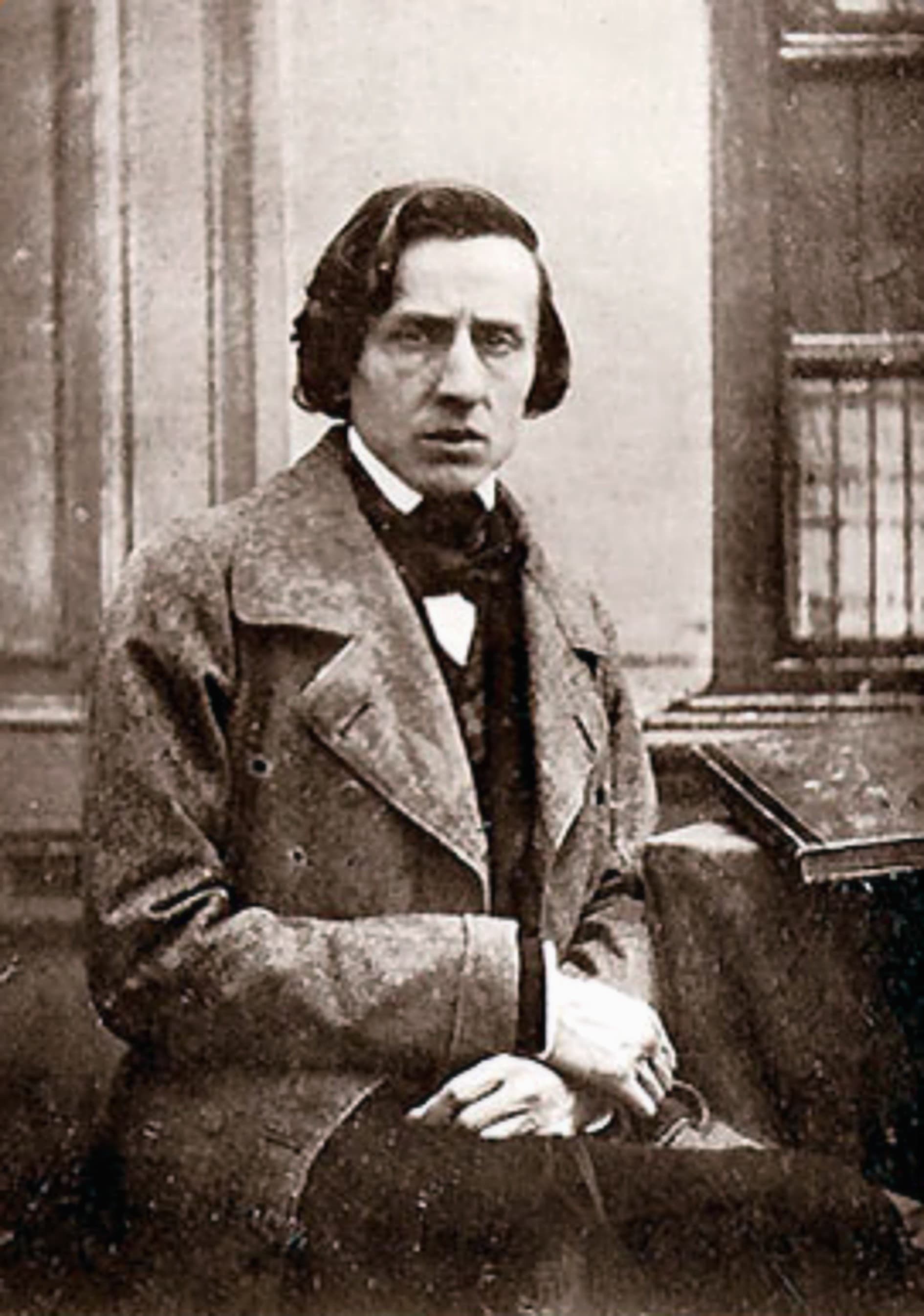






Something wrong on this page? or send a missing work.