Mikhail Glinka
- Born
- 1 June 1804
- Died
- 15 February 1857
- aged 52
- Country
- Russia
- Era
- Classical
- Wrote for
- Piano · orquestra · voz · violino · violoncelo
Михаил Иванович Глинка · Mihail Ivanovič Glinka · Michail Iwanowitsch Glinka
Biography
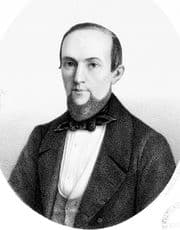
Mikhail Ivanovich Glinka was born on June 1, 1804, in the village of Novospasskoye, then part of the Russian Empire, and died on February 15, 1857. A Russian national, he was the first composer in the country to achieve widespread recognition within his own land, being considered the foundation of Russian classical music.
Raised under the care of his grandmother, who kept him in a comfortable and protected environment, Glinka heard, as a child, the bells of his village church and the choral songs of the peasants, sources that marked his sensitivity to the dissonant harmonies of local folk. Later, when he moved to his uncle's property, he attended orchestra performances that included works by Haydn, Mozart and Beethoven, and at the age of ten he heard a clarinet quartet by Bernhard Henrik Crusell, an experience that made a deep impression on him. He received piano and violin instruction and, at the age of thirteen, studied in Saint Petersburg, where he took piano lessons with John Field and, later, with Charles Mayer, beginning his own compositional practice.
Glinka's career gained prominence with the opera Life for the Tsar (1836), originally titled Ivan Susanin, which celebrated the figure of the patriotic peasant Ivan Susanin and received support from Tsar Nicholas I himself. In 1842 he premiered Ruslan and Ludia, based on a poem by Alexandre Pushkin, a work that, although initially received coldly, established itself as a landmark in the use of Russian popular melodies within an operatic structure. western. Among his orchestral compositions, the symphonic poem Kamarinskaya (1848), inspired by folk songs, and the Spanish works Uma Noite em Madrie Jota Aragonesa stand out. He also wrote numerous art songs, piano pieces and chamber music.
Glinka inaugurated a new direction in Russian music, by integrating elements of national folklore with European classical forms, inspiring later composers, including members of the “Fifty” and Pyotr Ilyich Tchaikovsky, who considered Kamarinskaya the seed of Russian symphony. His legacy was institutionalized with the Glinka Prize, created in 1884, and the naming of three Russian conservatories in his honor. On a personal level, his relationship with his nurse companion DonPedroFernández, who accompanied him in the last nine years of his life, and his sudden death in Berlin, followed by burial initially there and later transfer to the Alexandre-Nevsky Monastery cemetery, in Saint Petersburg, stood out.
Written by artificial intelligence and not yet reviewed by a person.
Where to start
Curiosities
- Is considered the father of Russian classical music.
- His opera "A Life for the Tsar" was the first important Russian opera.
- Influenced all subsequent development of Russian music.
- Combined Russian folk elements with European techniques.
Works
77 works- A Life for the TsarOrquestra · 1836
- A Farewell to Saint PetersburgVoz · 1840 · Advanced
- La séparationPiano · 1839
- Grand SextetViolino · 1832
- KamarinskayaOrquestra · 1848
- NocturnePiano · 1828
- 3 Russische LiederVioloncelo
- MazurkasPiano
- Jota Aragonesa, G.ii3Orquestra · 1845
- Divertimento brillianteOrquestra de Cordas · 1832
- 3 FuguesPiano · 1833-34
- Nocturne in Eb majorPiano · 1828
- 2 WaltzesPiano · 1838-39
- 20 Ausgewählte LiederVoz
- I Recall a Wonderful MomentPiano · 1840
- PolkaPiano · 1849
- Capriccio on Russian ThemesPiano · 1834
- DoubtViolino · 1838
- Prince KholmskyOrquestra · 1840
- Farewell WaltzPiano · 1831
- A Greeting to My HomelandPiano · 1847
- PrayerPiano
- Polka enfantinePiano · 1854
- PolonaisePiano · 1839
- 5 ContradansesPiano · 1839
- Impromptu-GalopPiano
- GalopPiano · 1838
- Initial PolkaPiano · 1840
- Mazurka in C minorPiano
- Do Not SayPiano · 1834



Something wrong on this page? or send a missing work.