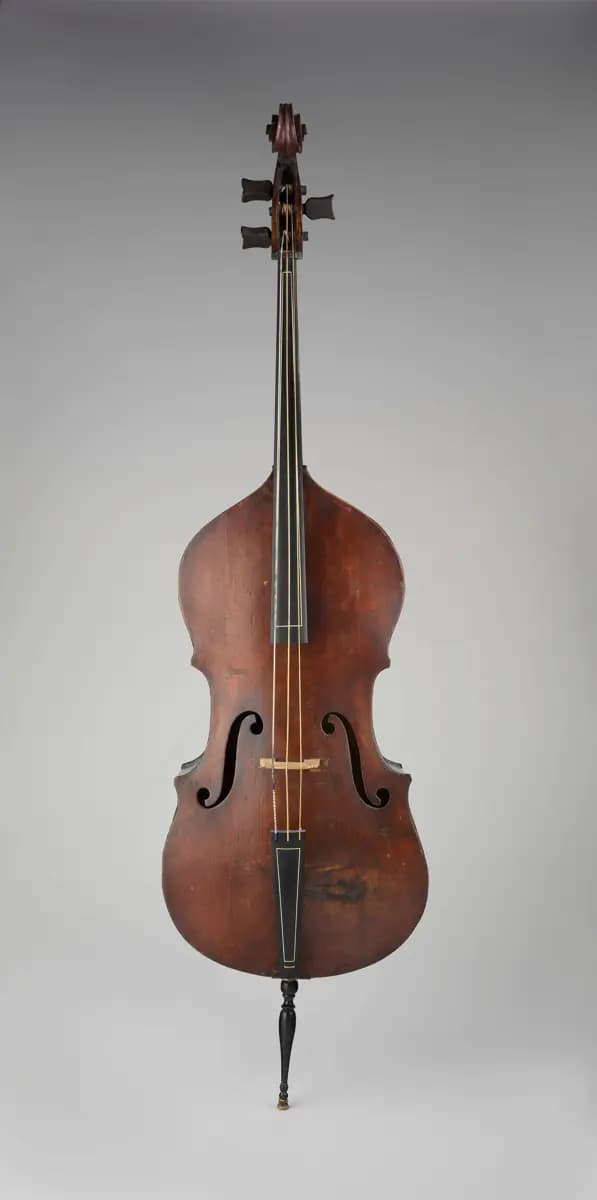
Double bass
Europe, 16th century
The double bass is the largest and lowest string instrument in the orchestra. Almost always at the back of the stage, it lays the floor everything else stands on.
Works for double bassHow it works
Unlike the rest of the family, it is tuned in fourths, E, A, D and G, so the hand can reach the notes without huge stretches. Its music sounds an octave lower than written, to avoid endless ledger lines. Players stand or sit on a high stool, using the bow or plucking the strings, pizzicato. There are two kinds of bow, French and German, held in different ways.
The story
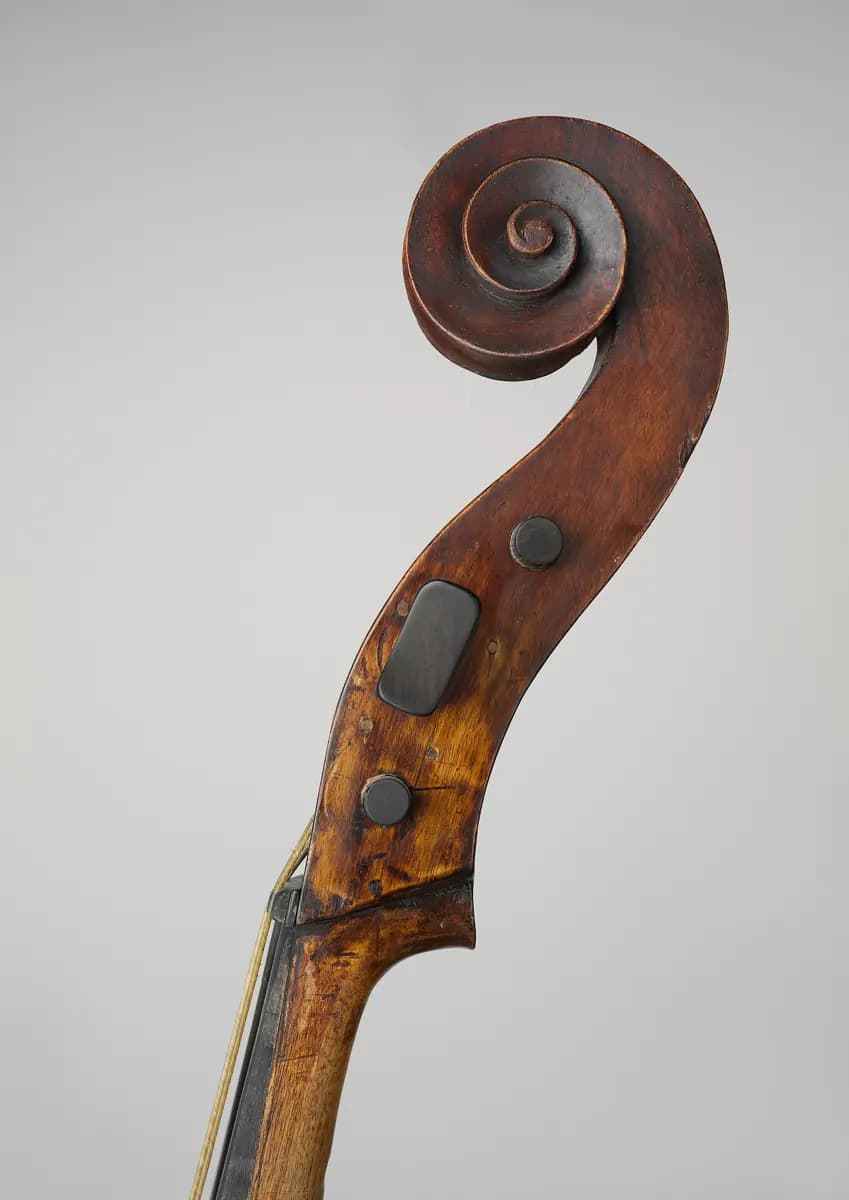
The double bass descends from the violone, the low member of the viol family, which is why it has sloping shoulders and is tuned in fourths, unlike the violin. In the Baroque and Classical periods it doubled the cello line an octave lower.
Two virtuosos changed its reputation. Domenico Dragonetti, a friend of Beethoven, played in London and astonished audiences with his technique. In the nineteenth century, Giovanni Bottesini, called the Paganini of the double bass, wrote concertos and fantasias to show that it could sing too.
In the twentieth century, the double bass found another stage in jazz, played pizzicato. In concert music, composers such as Saint-Saëns and Mahler gave it memorable solos, and today it has its own competitions and solo repertoire.
For a long time nobody agreed on how many strings it should have: three, four or five, tuned differently from country to country. There are also two ways to hold the bow, the French grip from above, like a cello’s, and the German grip from below, inherited from the viols. Orchestras use both to this day.
Serge Koussevitzky was a double bassist before he became one of the most famous conductors of the twentieth century, and in 1902 he wrote a concerto for the instrument that is still played. Later, soloists such as the American Gary Karr brought the bass into recital halls, and living composers keep writing for it.
What was written for it
In the orchestra, the whole symphonic repertoire. As soloist: the concertos of Dittersdorf, Vanhal and Koussevitzky and the works of Bottesini. In chamber music, Schubert’s “Trout” Quintet.
In pictures
Where to start listening
- 1The Carnival of the Animals: The ElephantCamille Saint-SaënsThe double bass dances a heavy, comic waltz. Open the work
- 2Symphony No. 1: third movementGustav MahlerIt begins with a solo double bass playing Frère Jacques in a minor key, like a funeral march. Open the work
- 3“Trout” Quintet: theme and variationsFranz SchubertThe double bass gives weight to a group with only one violin. Open the work
- 4Double Bass Concerto No. 2Giovanni BottesiniShows how lyrical and agile the instrument can be. Open the work
Did you know?
- Dragonetti played Beethoven’s G minor cello sonata with the composer, taking the cello part on a double bass. The story goes that it changed what Beethoven asked of the basses in the orchestra.
- Some bassists fit a mechanical extension to the lowest string to reach a low C, a note the orchestra asks for in Beethoven and Mahler.