 500–1400
Medieval
Almost all the medieval music we know was sung in churches and monasteries, because they were the ones who could write music down. Over nearly a thousand years, a single melody in Latin became two, three, then four voices at once.
The starting point is Gregorian chant, also called plainchant: Latin melodies sung in unison by monks, with no accompaniment. The name honours Pope Gregory I, who died in 604, but the credit is legend. The repertoire that reached us was put in order much later, in the eighth and ninth centuries, when the Carolingian kings wanted every church in their empire to sing the same way.
Singing the same way in distant places meant writing it down. The first signs, called neumes, appeared in the ninth century and showed only the shape of the melody: up, down, a wave. Singers who already knew a chant used them as a reminder. Around 1025 the monk Guido of Arezzo proposed horizontal lines to fix the pitch of each note, and a method for teaching people to sing at sight. The staff we use today comes from there.
The big news of the following centuries was singing more than one line at a time. At first, a second voice shadowed the chant at a fixed interval. In Paris around 1200, the musicians of Notre-Dame cathedral, Léonin and then Pérotin, wrote pieces in which new voices move freely and quickly over very long notes of the old chant. Pérotin went as far as four voices, a daring number for the time.
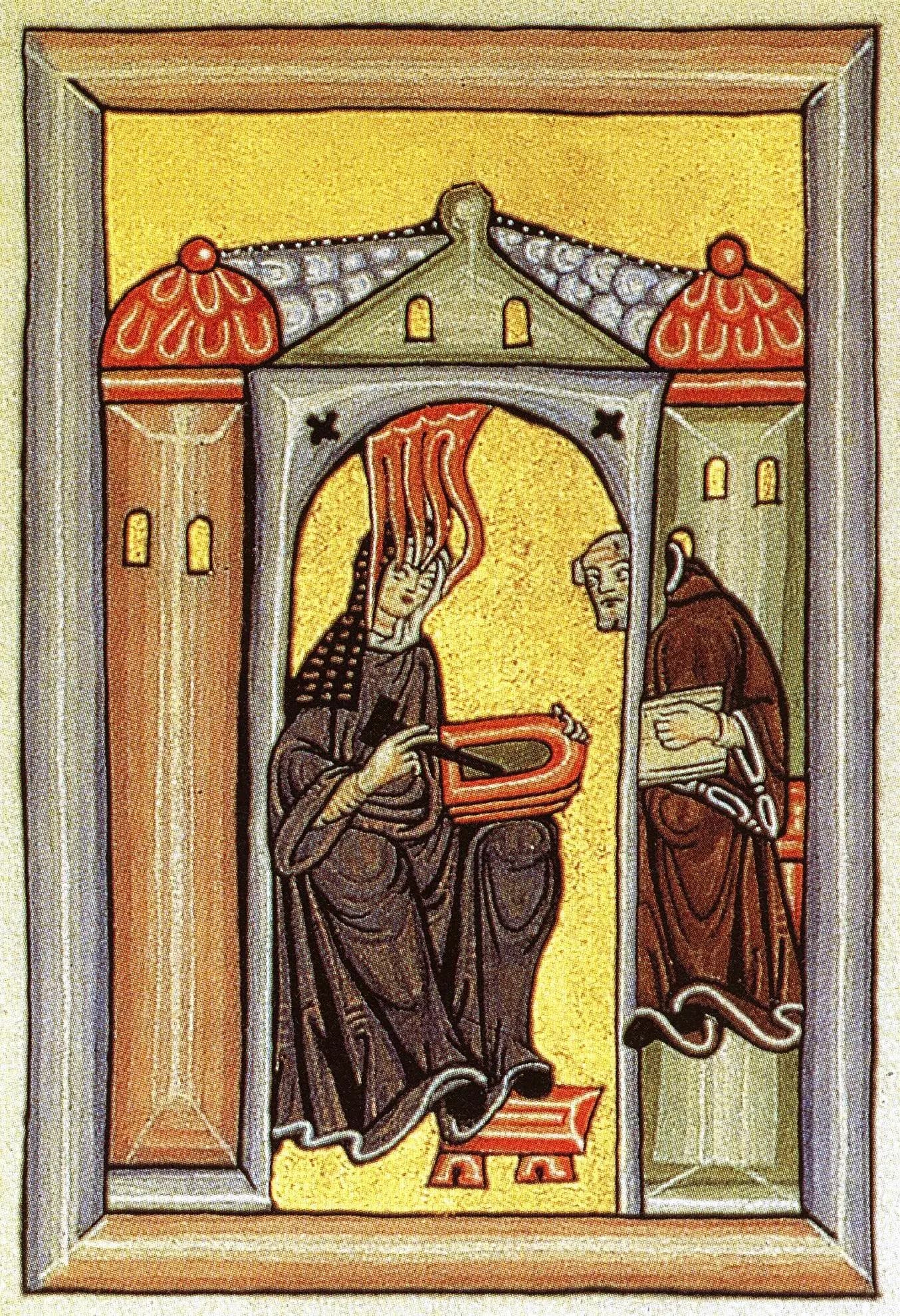
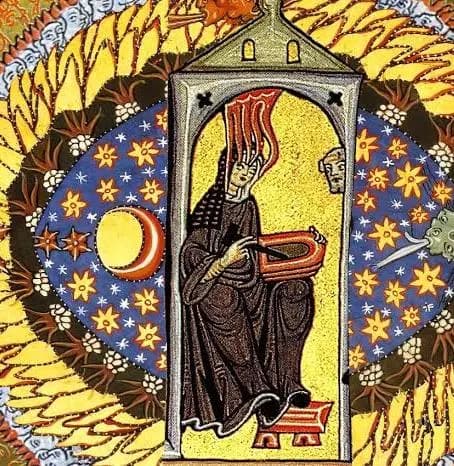
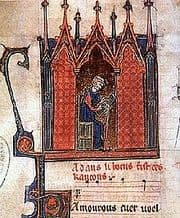
Outside the church there were love songs. The troubadours of southern France wrote in Occitan, the trouvères in the north in Old French, and the Minnesänger in German. Little of this music survives with its melody written out, and almost none with its rhythm. From the same centuries comes Hildegard of Bingen, a German abbess who composed chants with wide, soaring lines and wrote the Ordo Virtutum, a musical drama about the virtues and the soul.
In the fourteenth century, a treatise linked to Philippe de Vitry gave its name to a new art, the ars nova, with a notation able to record far more varied rhythms. The poet and composer Guillaume de Machaut wrote the Messe de Nostre Dame, the first complete polyphonic Mass we know by a single composer.
What changed
- 1Music gets written downFrom neumes, which recalled the outline of a melody, to Guido of Arezzo’s staff. For the first time, someone could sing music they had never heard.
- 2More than one voice at onceOrganum adds a second voice to the chant. At Notre-Dame the voices gain independence and reach four.
- 3Rhythm gets a notationFirst as repeating patterns, then, with the ars nova, as note shapes able to record varied, layered rhythms.
- 4Song in the people’s languageTroubadours and trouvères sing of love and chivalry in Occitan and French, far from the Latin of the church.
The forms of the era
- Gregorian chant
- Unaccompanied Latin melody for the Mass and the daily hours of the monastery.
- Organum
- The old chant in long notes, with one or more new voices above it.
- Motet
- Several voices, each with its own text, sometimes in different languages at once.
- Mass
- The fixed parts of the service (Kyrie, Gloria, Credo, Sanctus, Agnus Dei) set in polyphony.
- Fixed-form song
- Ballade, rondeau and virelai: poems with refrains, each with its own pattern of repeats.
Who lived in it
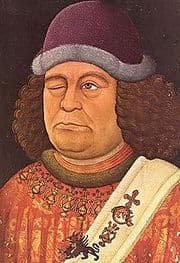
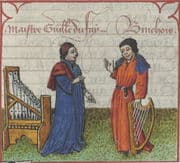
Some composers of the era, on the timeline.

Where to start listening
Works of this era- 01Victimae paschali laudesAnonymousA Gregorian sequence for Easter. Good for feeling unison chant, unhurried.Open the work
- 02O vis aeternitatisHildegard of BingenVery wide lines that climb and fall a whole octave in a few notes.Open the work
- 03Viderunt omnesPérotinFour voices dancing over notes that last several seconds. It sounds like a cathedral.
- 04Sumer is icumen inAnonymousA thirteenth-century English round about summer arriving, with the cuckoo singing.Open the work
- 05Messe de Nostre DameGuillaume de MachautStart with the Kyrie: four voices, interlocking rhythms, a rough and brilliant sound.Open the work
Did you know?
- The names of the notes come from a hymn to Saint John the Baptist, Ut queant laxis. Each line starts one step higher than the last, and Guido used the opening syllables (ut, re, mi, fa, sol, la) to teach singing. Ut later became do, which is easier to sing.
- Sumer is icumen in is one of the oldest rounds known: up to six voices sing the same tune, entering one after another.
- Hildegard of Bingen also wrote about medicine, plants and mystical visions, and corresponded with popes and emperors.